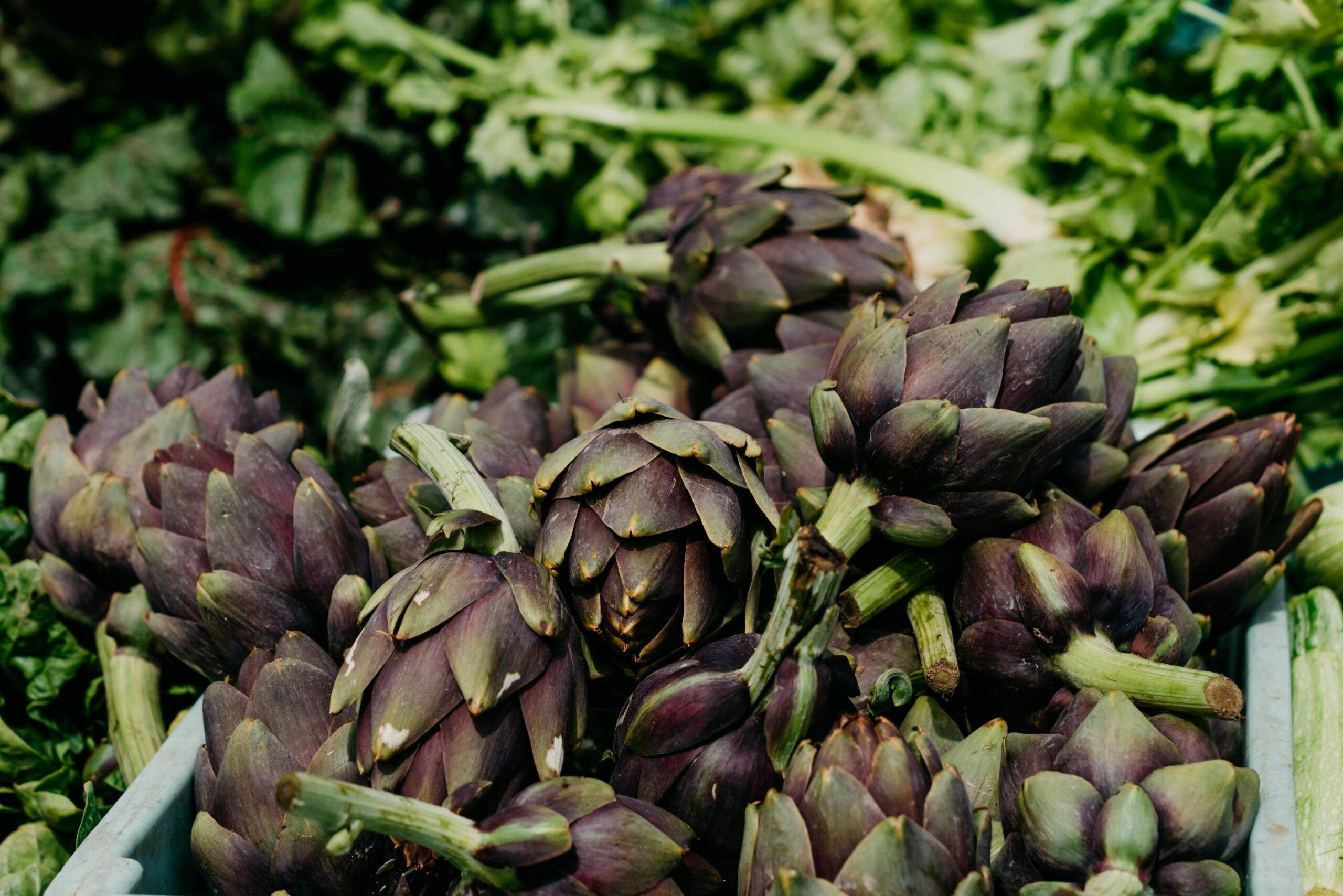
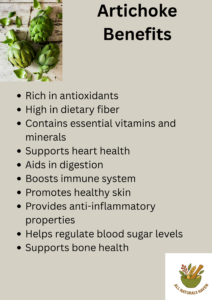
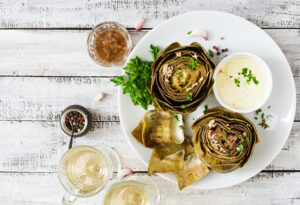
Artichoke, also called “alcachofra” or “artichout” in some dialects, belongs to the family Asteraceae and has been used as a digestive aid and delicacy by native cultivars. The ‘heart’ receptacle is edible and should not be confused for Jerusalem artichoke. Its uses are outlined in the image below.
Jump to: Health uses and ethnopharmacological profile
Artichoke Description
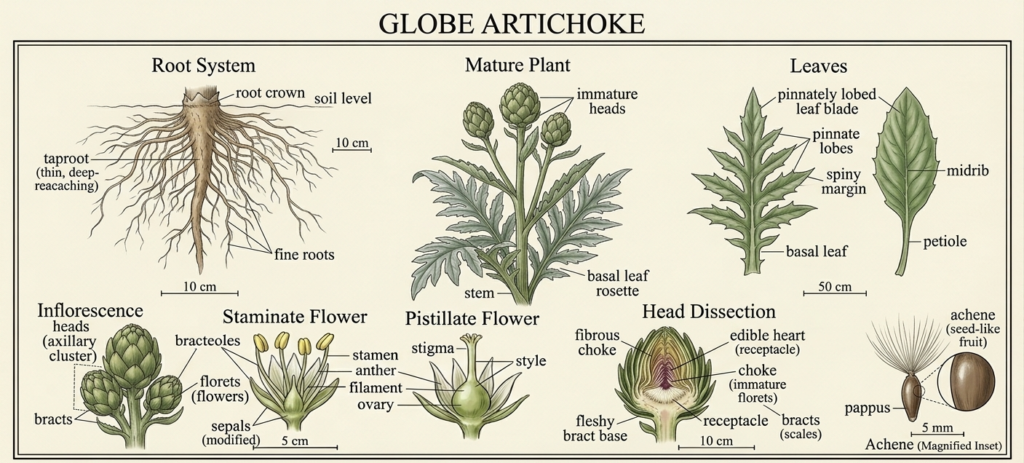
The artichoke has an erect stem with wide thistle-like leaves that are gray-green and lobed. The flowers are purple and green and enclosed in bracts or scales. The plant contains bitter sesquiterpenes, enzymes, flavonoids, polyphenols, fats, carbohydrates, proteins, inulin fiber, folic acid, niacin, thiamine, carotenoids, calcium, potassium, and phosphorus.
Health Uses and ethnopharmacological profile of Artichoke
Traditional uses
In French, artichoke was used as a liver tonic and in aiding hepatic diseases, jaundice, dyspepsia, and chronic albuminuria. The leaves were used as a choleretic to stimulate bile flow from the liver and gallbladder. The Romans used it as a digestive aid.
Health uses and Research
Anti-inflammatory uses– scolymus leaf extracts have proven to reduce inflammation in cultured cells. The compounds cynarin and luteolin act by inhibiting pathways that lead to inflammation, such as thwarting the synthesis and release of pro-inflammatory mediators like tumor necrosis factor alpha.
Antimicrobial effects– In lab settings, probiotic-enriched artichoke heads proved effective against E. coli and Clostridium spp. The fruit extract worked against Campylobacter spp. At 500 mg, it was able to work against MRSA. Caffeoylquinic acid was one of the compounds isolated to increase bacterial cell permeability, causing death.
It also portrayed antifungal activity through interfering with ergosterol-associated membrane stability. Zhu 2005
Antioxidant activity– extracts showed activity in vivo against carbon tetrachloride, lead, paracetamol, and cadmium-induced toxicity. This was through scavenging of reactive oxygen species and increasing endogenous antioxidants like catalase.
Antitumor activity– In in vitro studies, extracts containing rutin, gallic acid, and quercetin showed protection against ovary-induced lesions, inhibited cell viability of myeloid leukemia, and also inhibited proliferation of human colorectal cancer DLD1 cells.
Cardiovascular effects– In an animal model, there was an observed reduction in cholesterol levels and a decrease in both systolic and diastolic pressure. Its polyphenol content is believed to inhibit cholesterol synthesis in the liver by downregulating the HMG-COA reductase enzyme activity.
Hypoglycemic properties- extract at a dose of 1800 mg daily for 12 weeks reduced triglyceride levels in carriers of the A allele. This was thought to be through mechanisms like promoting fatty acid oxidation and reducing triglyceride synthesis.
Gastrointestinal effects– extracts were able to increase probiotic bacterial count and treat constipation. Inulin acts as a substrate for beneficial gut flora, Bifidobacterium and Lactobacillus, boosting their colonies and associated benefits, like improved barrier function.
Hepatoprotective effects– at a 600 mg daily dose for 2 months, there were recorded good liver parameters like hepatic vein flows and size. Polyphenols like chlorogenic acid induced this effect through boosting bile secretion and increasing lipid metabolism that eventually reduced hepatic fat accumulation, promoting a healthy liver in the process. Panahi 2018
Renal activity- Alongside gentamicin, extracts of artichoke showed normalization of kidney parameters in rats. Polyphenols may act by protecting cells through preventing apoptosis triggered by nephrotoxicity.
NB– Artichoke increases the serum level of colchicine; people on antigout drugs should generally avoid taking its extracts.
REFERENCES
Porro, C., Benameur, T., Cianciulli, A., Vacca, M., Chiarini, M., De Angelis, M., & Panaro, M. A. (2024). Functional and Therapeutic Potential of Cynara scolymus in Health Benefits. Nutrients, 16(6), 872. https://doi.org/10.3390/nu16060872
Zapolska-Downar D, Zapolski-Downar A, Naruszewicz M, Siennicka A, Krasnodebska B, Kołdziej B. Protective properties of artichoke (Cynara scolymus) against oxidative stress induced in cultured endothelial cells and monocytes. Life Sci. 2002 Nov 1;71(24):2897-08. doi: 10.1016/s0024-3205(02)02136-7. PMID: 12377270.
Villarini, M., Acito, M., di Vito, R., Vannini, S., Dominici, L., Fatigoni, C., Pagiotti, R., & Moretti, M. (2021). Pro-Apoptotic Activity of Artichoke Leaf Extracts in Human HT-29 and RKO Colon Cancer Cells. International Journal of Environmental Research and Public Health, 18(8), 4166. https://doi.org/10.3390/ijerph18084166
Ben Salem M, Affes H, Dhouibi R, Charfi S, Turki M, Hammami S, Ayedi F, Sahnoun Z, Zeghal KM, Ksouda K. Effect of Artichoke (cynara scolymus) on cardiac markers, lipid profile and antioxidants levels in tissue of HFD-induced obesity. Arch Physiol Biochem. 2022 Feb;128(1):184-194. doi: 10.1080/13813455.2019.1670213. Epub 2019 Sep 28. PMID: 31564131.
Rezazadeh K, Rahmati-Yamchi M, Mohammadnejad L, Ebrahimi-Mameghani M, Delazar A. Effects of artichoke leaf extract supplementation on metabolic parameters in women with metabolic syndrome: Influence of TCF7L2-rs7903146 and FTO-rs9939609 polymorphisms. Phytother Res. 2018 Jan;32(1):84-93. doi: 10.1002/ptr.5951. Epub 2017 Nov 29. PMID: 29193419.
Marteau P. Therapy: Probiotic-enriched artichokes for abdominal discomfort. Nat Rev Gastroenterol Hepatol. 2012 Mar 20;9(5):251-2. doi: 10.1038/nrgastro.2012.49. PMID: 22429956.
Panahi Y, Kianpour P, Mohtashami R, Atkin SL, Butler AE, Jafari R, Badeli R, Sahebkar A. Efficacy of artichoke leaf extract in non-alcoholic fatty liver disease: A pilot double-blind randomized controlled trial. Phytother Res. 2018 Jul;32(7):1382-1387. doi: 10.1002/ptr.6073. Epub 2018 Mar 9. PMID: 29520889.
Leave a Reply