
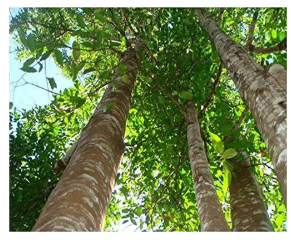
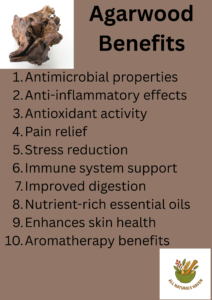
Agarwood, also commonly called oud/oudh, eaglewood, and wood of the gods, is a plant primarily used in the manufacturing of aromatic scents in perfumery. It is rich in terpenes and sesquiterpenes, genkwanins, mangiferins, phenolic acids, and flavonoids. Its uses are outlined in the image below.
Jump to: Health uses and ethnopharmacological profile
Agarwood Description
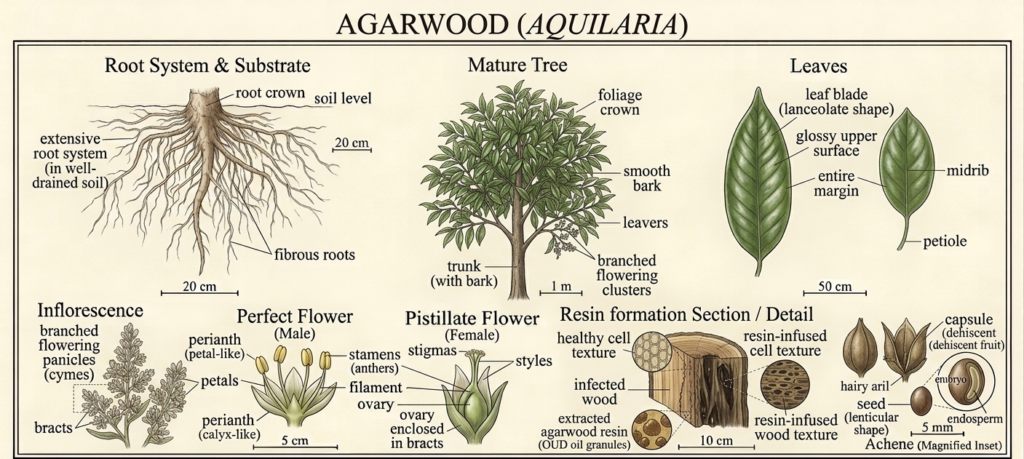
It has a cylindrical trunk and a rough bark with fissures. The leaves are oblong and leathery with a green color. They are aromatic when crushed. The flowers are fragrant with whitish, yellowish, or greenish colors. The seeds are encapsulated within a woody capsule-like fruit.
It is found in South and East Asia as a native plant but is also farmed in some parts of China, Saudi Arabia, and the UAE. The relevant species include A. malaccensis, A. crassna, and A. sinensis.
Health Uses and ethnopharmacological profile of Agarwood
Traditional uses
It has been used in herbal remedies as a sedative; in Thailand, it was used as a digestive aid, and in China, its extracts were used to calm down asthma symptoms. It has also been used in fragrance as oud.

Health Uses and Research
Antitumor potential– essential oil extracts of A. crassna, either as a single dose of 2000 mg/kg or a range of 100 or 500 mg/kg for 28 days, inhibited tumor growth in mice. Bioactive compounds assisted programmed cell apoptosis and disrupted the cell cycle, thus thwarting proliferation. Other noted indirect benefits were lower tumor compactness and reduced vascularization. Daham 2016
Anti-inflammatory/analgesic potential– sesquiterpene extracts suppressed inflammatory mediators, showing anti-inflammatory activities on in vitro mouse macrophage cells. These were observed by decreased COX-2 protein expression and reduced activation of inflammatory signaling proteins.
Mechanisms suspected include downregulation of nitric oxide production and inhibition of expression of cytokines and inflammatory enzymes.
Calming effect potential– agarwood essential oil inhalation or ingestion slowed down motor activity, eliciting a calming effect in rats through observed reduced locomotor activity and even inducing sleep. Sesquiterpenes are suspected to produce these effects through enhancing GABA signaling, which reduces neuronal firing in the brain, leading to sedation and reduced motor activity. Sesquiterpenes can cross the blood-brain barrier. Wang 2023
Laxative potential– in vivo studies showed acetone or ethanol extract increased stool frequency and weight without causing diarrhea. This activity was linked to genkwanin-5-O-β-primeveroside.
Cardiovascular potential– ethanolic extracts and isolated sesquiterpene chromones were able to elicit a reduction of heart rate and blood pressure in animal models. it was also able to protect against myocardial ischemia and improved myocardial histology after stress insults.
The likely mechanism of action is through suppression of the MAPK pathway that reduces apoptosis and necrosis of cardiomyocytes when deprived of oxygen.
Insecticide potential– Essential oils and ethanolic extracts were tested by spraying, feeding assays, and fumigations of mosquitoes, agricultural pests, and insects. The result was a dose-dependent insect mortality, larvicidal death, and reduced feeding and movement.
These outcomes were linked to the mechanism of induced neurotoxicity by sesquiterpenes and the inhibition of acetylcholinesterase enzymes leading to paralysis and eventually death. Gogoi 2023
NB– Little research has been done into agarwood; therefore, it is advisable to use it as a perfume or in aromatherapy, as it is widely used for.
REFERENCES
Ma CT, Ly TL, Le THV, Tran TVA, Kwon SW, Park JH. Sesquiterpene derivatives from the agarwood of Aquilaria malaccensis and their anti-inflammatory effects on NO production of macrophage RAW 264.7 cells. Phytochemistry. 2021 Mar;183:112630. doi: 10.1016/j.phytochem.2020.112630. Epub 2020 Dec 27. PMID: 33378718.
Hara H, Ise Y, Morimoto N, Shimazawa M, Ichihashi K, Ohyama M, Iinuma M. Laxative effect of agarwood leaves and its mechanism. Biosci Biotechnol Biochem. 2008 Feb;72(2):335-45. doi: 10.1271/bbb.70361. Epub 2008 Feb 7. PMID: 18256503.
Wang S, Yu Z, Wang C, Wu C, Guo P, Wei J. Chemical Constituents and Pharmacological Activity of Agarwood and Aquilaria Plants. Molecules. 2018 Feb 7;23(2):342. doi: 10.3390/molecules23020342. PMID: 29414842; PMCID: PMC6017114.
Leave a Reply