
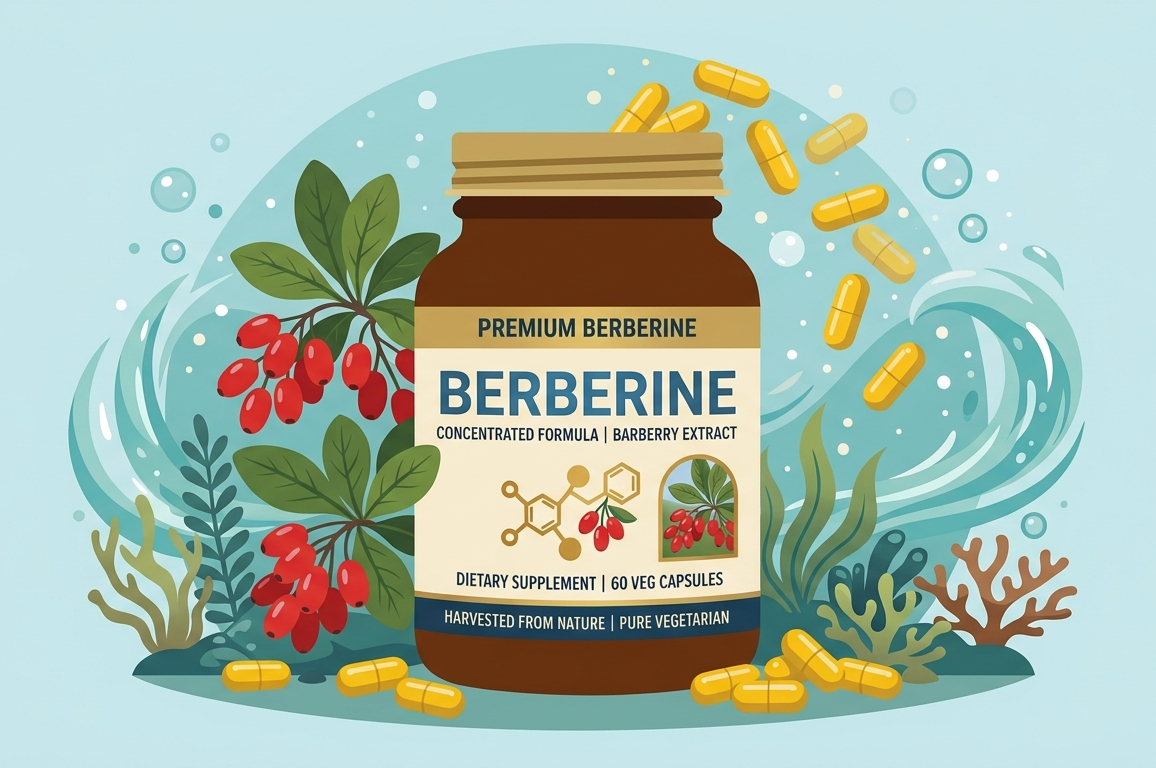
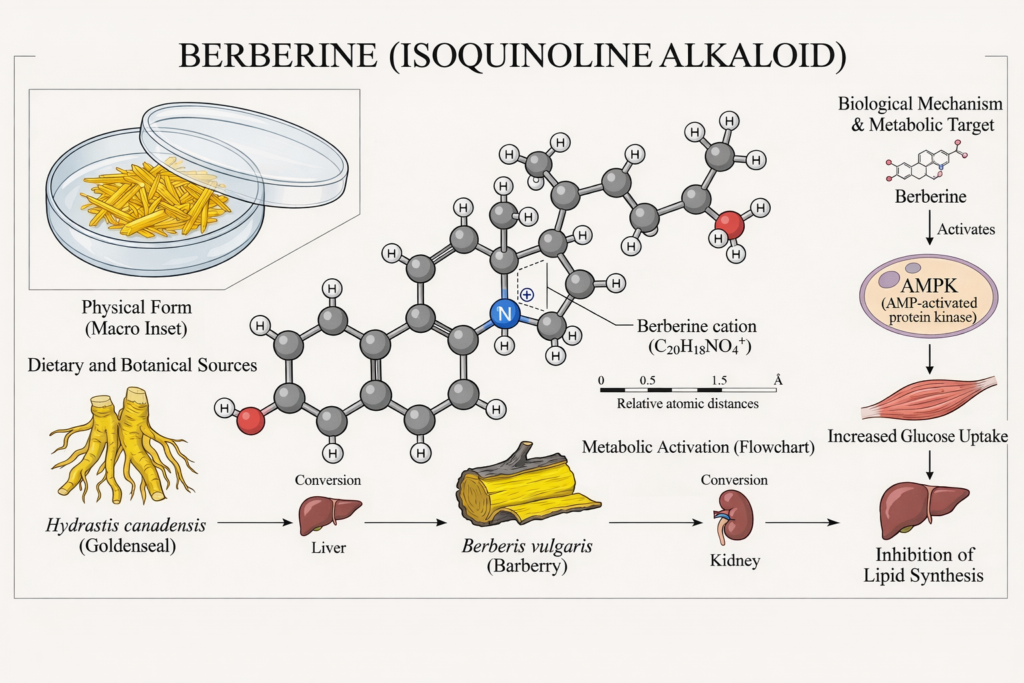
Berberine is a natural bioactive alkaloid commonly referred to as nature’s Ozempic due to its ability to reduce fats and promote weight loss. It is derived from golden seal, barberry, and Oregon grape. In powder form, it is crystalline, vibrant fluorescent yellow, with a bitter taste and low solubility.
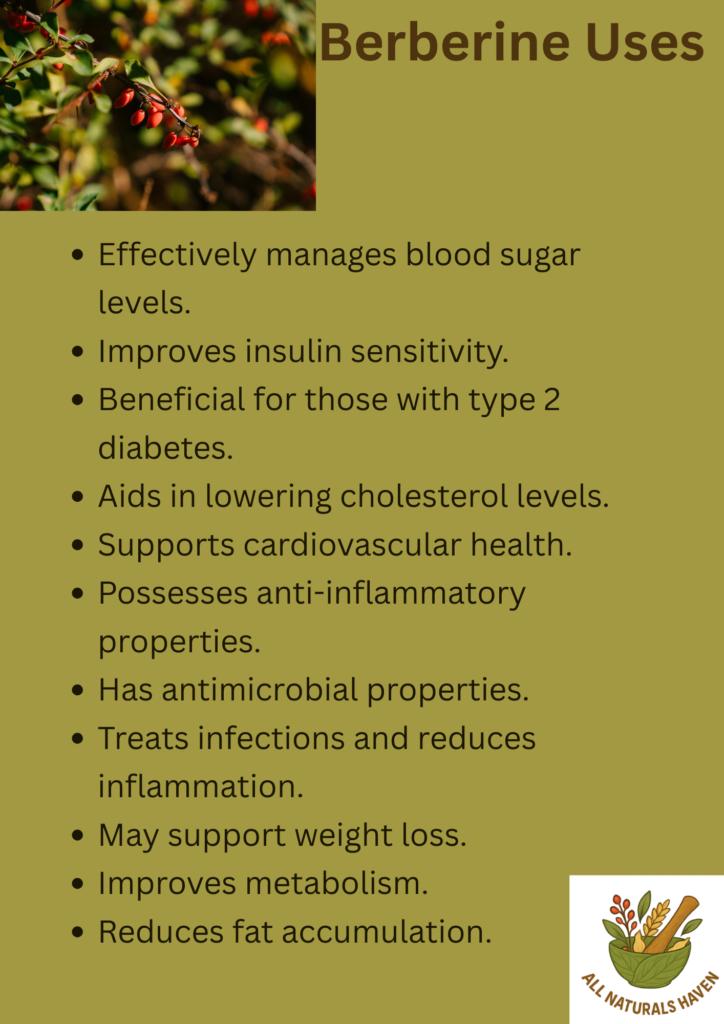
Berberine binds to many enzymes, is photosensitive, and has a flat planar structure, which enables DNA intercalation. The image below contains the uses of berberine.
Jump to section
Forms of Berberine
Berberine hydrochloride (Hcl)
This is berberine formulated with a hydrochloride. It is used for general metabolic support. It may cause gastrointestinal issues (SIBO) because it is poorly absorbed, and large amounts may persist in the intestines longer. In high doses, it may lead to berberine belly (cramping and diarrhea). The dose is 1000-1500 mg.
Berberine phytosomes
This is formulated via phytosome technology of phospholipid and pea protein integration with the berberine. It is used in weight loss and metabolic syndrome. A lower dose of 500 achieved desirable concentration and results, but it can go up to 1000 mg a day.
Dihydroberberine
This is a hydrogenated (adding two hydrogen ions) berberine extract. T is converted into berberine after it passes through the intestinal wall. It is used in periods of sugar spikes and also in athletic performance. It is a highly soluble form and starts to work fast without needing any loading dose. The dose ranges from 100 to 200 mg.
Berberine sulphate
This is used in specific clinical setups and is less common. It is used as an ophthalmic and dermatological allocation. It has found use in trachoma, redness, and skin infections, though in a more traditional role.
Health benefits and ethnopharmacological profile of berberine
Traditional Uses
The Huang lian plant part rich in berberine was used in inflammation, purging of toxins, and as a topical wash for eyes (conjunctivitis), ears, and skin conditions. The daru haldi plant was used as a bitter tonic, blood purifier, and jaundice treatment. The wash from golden seal and Oregon grape was used in skin diseases and sore eyes and internally as a tonic.
Clinical uses and Research
Weight and obesity: It showed modest but consistent reduction in BMI and body weight after 12 weeks of usage, at a dose of 1 gram daily. It acted through thermogenesis, increasing brown adipose tissue activity. It also inhibited adipogenesis via PPAR-gamma inhibition.
Improving gut microbiome: After 3 months of consistent use, there was improved intestinal barrier function and a reduction in SIBO. This was via selective microbial action and increasing short-chain fatty acid-producing bacteria.
Type 2 diabetes: It reduced HbA1c and fasting blood glucose levels at a dose of 1500 mg comparable to metformin. This was via AMPK activation, increasing GLUT-4 translocation of cell membranes and inhibition of gluconeogenesis. ( J Lan 2015)
Heart failure: In a 2-year follow-up study, it improved quality of exercise capacity and survival rates in people with chronic heart failure. It acts by enhancing cardiac energy metabolism, acting as a mild vasodilator, and improving calcium handling in heart muscle cells.
Hyperlipidemia: Berberine reduced cholesterol by 20-50 mg/dl. Triglycerides and total cholesterol levels. This was via increasing the expression of LDLR in the liver and inhibition of PCSK9, which reduces intestinal cholesterol absorption. (Kong 2005)
Fatty liver: The extract reduced liver enzyme markers (AST/ALT) and overall liver fat content in non-alcoholic fatty liver. It acts by promoting clearing of damaged mitochondria, reduced hepatic lipid accumulation, and improved mitochondrial dynamics.
Polycystic ovarian syndrome: It elicited improved ovulation and menstrual regularity alongside a reduction in waist-to-hip ratio and visceral fats. This was through reducing insulin resistance and increasing SHBG, which lowers free testosterone and restores ovarian autophagic flux. (Jurgiel 2024)
Metabolic syndrome: It reduced systolic blood pressure and inflammatory markers and improved flow-mediated dilation of arteries. It acted by improving endothelial blood flow function and stalling the effects of cyclooxygenase 2 and NF-κB inflammatory factors.
Safety and Dosing profile of Berberine
Side effects
- Diarrhea or constipation
- Cramps and flatulence
- Nausea
- Risk of hypoglycemia
- Headache and dizziness
- Liver enzyme elevation
Interactions
- Statins- possible increased risk of myopathy
- Cyclosporine, clarithromycin- may increase to dangerous levels
- Sedatives- may increase drowsiness
- Diabetes medication- may lead to hypoglycemia
- Antihypertensives- increase vasodilation
- Blood thinners
Contraindications
- Pregnancy and breastfeeding- leads to kernicterus
- Children and infants- risk of jaundice
- Kidney and liver diseases
- Upcoming surgery
REFERENCES
Domuschiev, Ivan. (2025). Berberine-non-toxic natural molecule for weight loss. 10.13140/RG.2.2.34714.96967.
Feng X, Sureda A, Jafari S, Memariani Z, Tewari D, Annunziata G, Barrea L, Hassan STS, Šmejkal K, Malaník M, Sychrová A, Barreca D, Ziberna L, Mahomoodally MF, Zengin G, Xu S, Nabavi SM, Shen AZ. Berberine in Cardiovascular and Metabolic Diseases: From Mechanisms to Therapeutics. Theranostics. 2019 Mar 16;9(7):1923-1951. doi: 10.7150/thno.30787. PMID: 31037148; PMCID: PMC6485276.
Ionita-Radu, F., Patoni, C., Nancoff, A. S., Marin, F.-S., Gaman, L., Bucurica, A., Socol, C., Jinga, M., Dutu, M., & Bucurica, S. (2024). Berberine Effects in Pre-Fibrotic Stages of Non-Alcoholic Fatty Liver Disease—Clinical and Pre-Clinical Overview and Systematic Review of the Literature. International Journal of Molecular Sciences, 25(8), 4201. https://doi.org/10.3390/ijms25084201
Velasco-Aburto, S., Llama-Palacios, A., Sánchez, M. C., Ciudad, M. J., & Collado, L. (2025). Nutritional Approach to Small Intestinal Bacterial Overgrowth: A Narrative Review. Nutrients, 17(9), 1410. https://doi.org/10.3390/nu17091410
Xia LM, Luo MH. Study progress of berberine for treating cardiovascular disease. Chronic Dis Transl Med. 2016 Jan 12;1(4):231-235. doi: 10.1016/j.cdtm.2015.11.006. PMID: 29063012; PMCID: PMC5643735.
Leave a Reply