
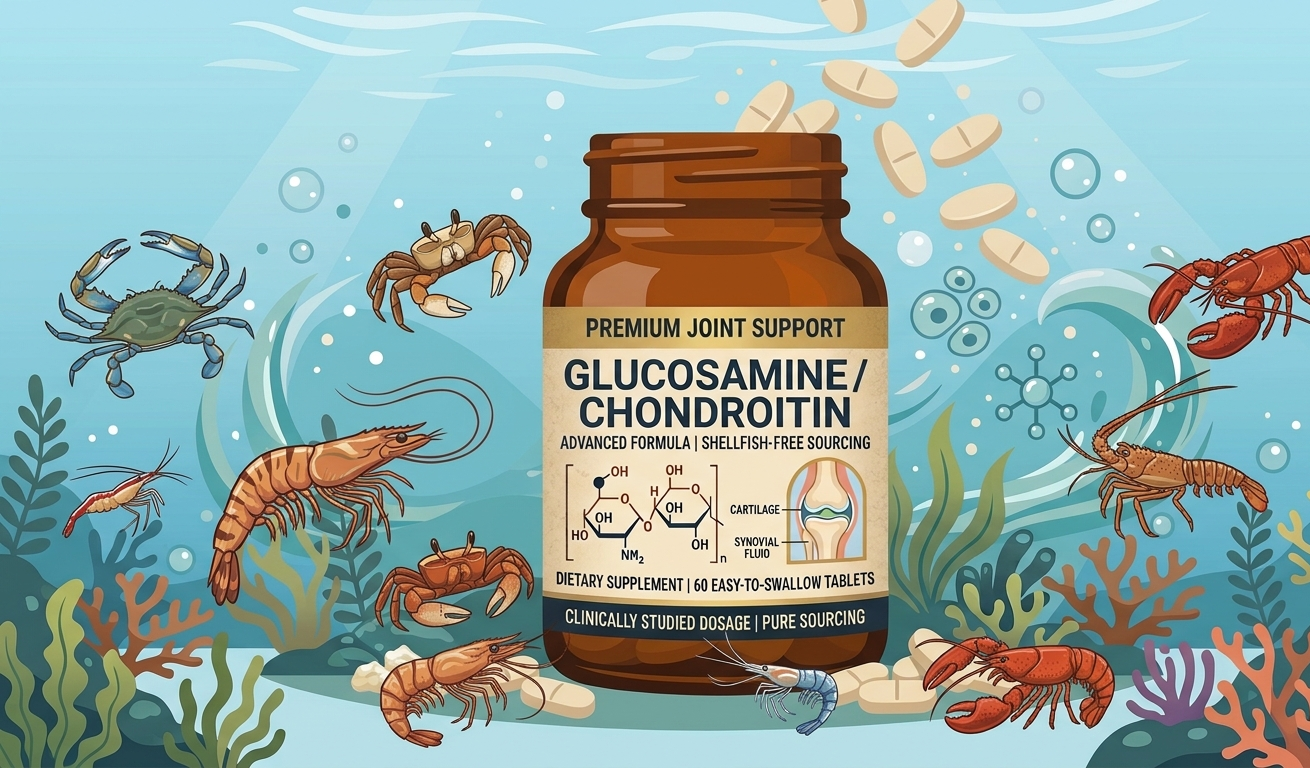
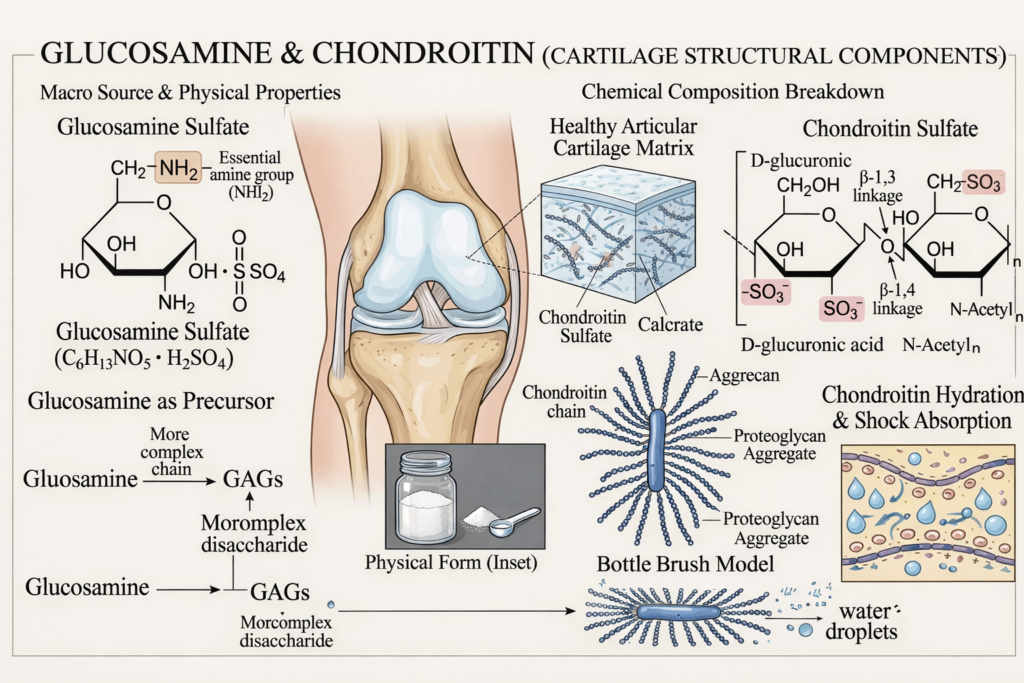
Glucosamine and chondroitin are natural components of human cartilage. The cartilage is the part of the joint fluid that is softer than bone but much tougher than muscles. The function of the cartilage is to:
- Reduce friction
- Act as a shock absorber
- Part of structural support
Glucosamine is the natural glue made up of proteoglycans and collagen and the precursor to glycosaminoglycans. It starts the production of the intracellular matrix and is part of the synovial fluid that lubricates the joints. It also aids in cell signaling and water retention.
Chondroitin is the sponge component of the extracellular matrix. It serves to pull water into the cartilage tissue through its hydrophilic nature. It serves to nourish the cartilage, which lacks blood vessels. It is larger than glucosamine and is the part that aids in shock absorption, stretch integrity, and filtering fluid movement.
Jump to section
- Glucosamine/chondroitin formulation
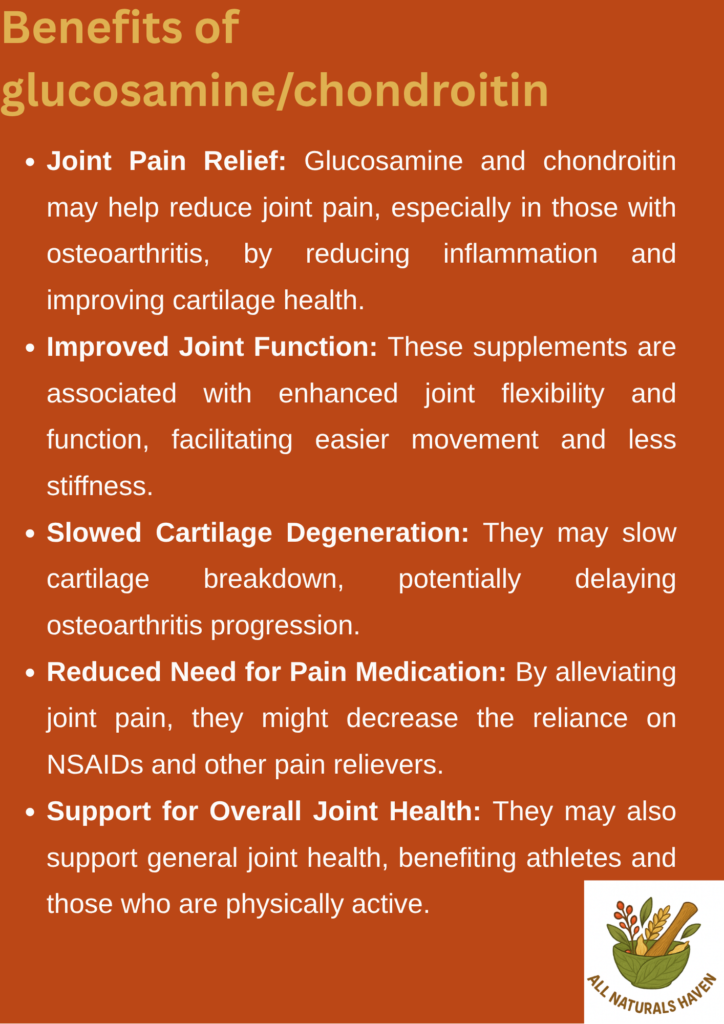
- Health benefits and ethnopharmacological profile
- Safety and dosing profile
Formulations of Glucosamine/chondroitin
Sources of glucosamine chondroitin are exoskeletons and connective tissues such as shells of shrimps, lobsters, and crabs (chitin converted to glucosamine); fungi (Aspergillus niger); animal bone marrows and joints (broth from cows, goats, and chickens); cartilage (bovine, porcine, and shark); and marine sources (skeletons of skates, rays, and fish).
They are formulated as sulfates, hydrochlorides, or N-acetyl compounded extracts. The sulfates with sulfur also help the body in building cartilage. The hydrochloride is cheaper to manufacture and provides more glucosamine but is more of a hit-or-miss formulation. N-acetyl cysteine glucosamine is specifically for gut health in repairing digestive tract lining. Chondroitin is often stabilized with sodium.
Rationale for combination: It boosts structural and functionality aspects. Glucosamine provides material that focuses on growth and repair, while chondroitin focuses on protection, lubrication, and nutrient supply that block enzymes trying to degrade the cartilage.
There is enhanced absorption as glucosamine primes and prepares the gut for chondroitin, which is a larger compound. It also promoted better drug compliance by reducing pill count.
Health Benefits and ethnopharmacological profile of Glucosamine/Chondroitin
Clinical Uses and Research
Pain scores in women: It elicited a 50% reduction in pain and stiffness comparable to the drug celecoxib. It acted by inhibiting inflammatory markers and joint swelling at a dose of 1500/1200 over six months.
In another subgroup study of pain, 79 % of the active group had pain relief compared to the placebo group. It was believed that glucosamine and chondroitin inhibited cartilage-degrading enzymes.
Joint space width (through X-ray measurements): the supplement protected collagen mesh from thinning. This was via the action of narrowing the joint space as compared to the placebo group.
Knee osteoarthritis: Glucosamine outperformed an acetaminophen group in eliciting long-term symptom relief from pain and stiffness. With MRI imaging of the cartilage volume, it showed a cartilage-sparing effect. There was lower volume lost compared to the placebo group. (LEGS 2015)
Safety and Dosing profile of Glucosamine/Chondroitin
Dosing
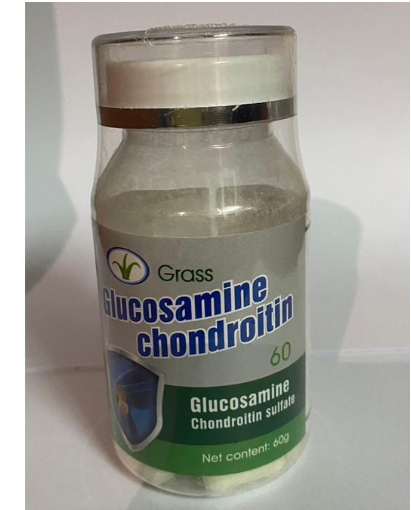
Glucosamine- 1500 1500 mg daily max
Chondroitin- 800 to 1200 mg max
Preferably taken with food.
Side effects and Contraindications
- Nausea, heartburn and diarrhea
- Avoid in known shellfish allergy.
REFERENCES
Hochberg M, Martel-Pelletier J, Monfort J .Combined chondroitin sulfate and glucosamine for painful knee osteoarthritis: a multicentre, randomised, double-blind, non-inferiority trial versus celecoxib
Jerosch, Jörg, Effects of Glucosamine and Chondroitin Sulfate on Cartilage Metabolism in OA: Outlook on Other Nutrient Partners Especially Omega-3 Fatty Acids, International Journal of Rheumatology, 2011, 969012, 17 pages, 2011. https://doi.org/10.1155/2011/969012
Sawitzke AD, Shi H, Finco MF, Dunlop DD, Bingham CO 3rd, Harris CL, Singer NG, Bradley JD, Silver D, Jackson CG, Lane NE, Oddis CV, Wolfe F, Lisse J, Furst DE, Reda DJ, Moskowitz RW, Williams HJ, Clegg DO. The effect of glucosamine and/or chondroitin sulfate on the progression of knee osteoarthritis: a report from the glucosamine/chondroitin arthritis intervention trial. Arthritis Rheum. 2008 Oct;58(10):3183-91. doi: 10.1002/art.23973. PMID: 18821708; PMCID: PMC2836125.
Leave a Reply