

Vitamin D3 is a fat-soluble vitamin that the skin synthesizes in the presence of mild amounts of UVB radiation. It is also called the sunshine vitamin. When synthesized, it is a crystalline white to yellowish powder, insoluble in water but soluble in organic solvents (fatty oils/ethanol/chloroform). It degrades in air, light, and heat.
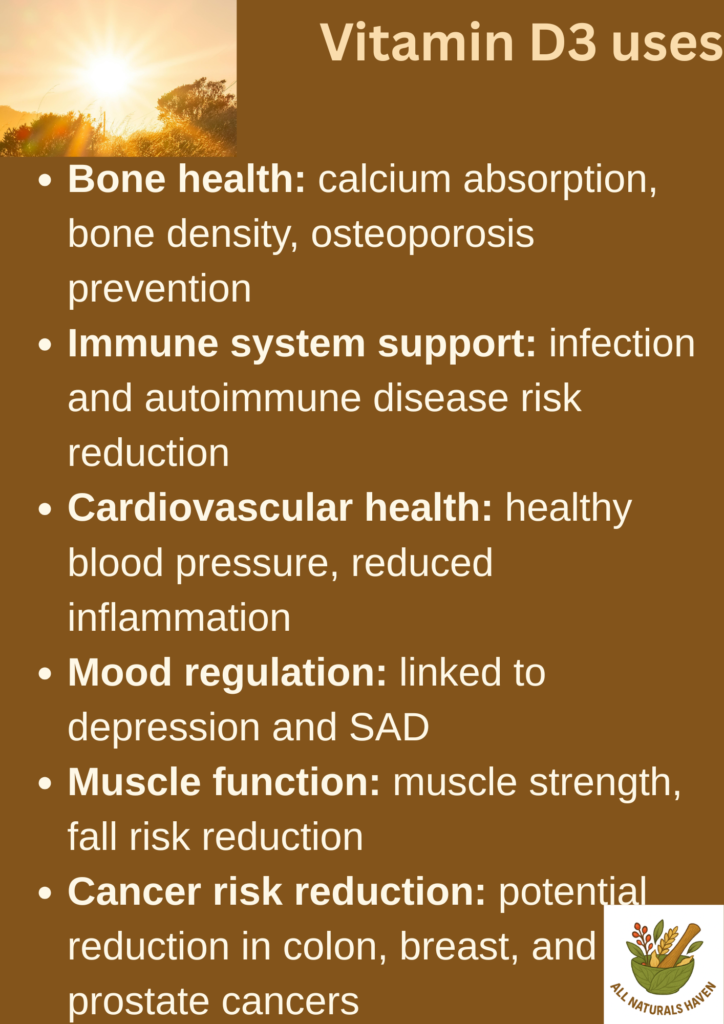
Vitamin D3 uses are listed in the image below.
Jump to: health benefits and ethnopharmacological profile
Vitamin D3 Biological Mechanisms
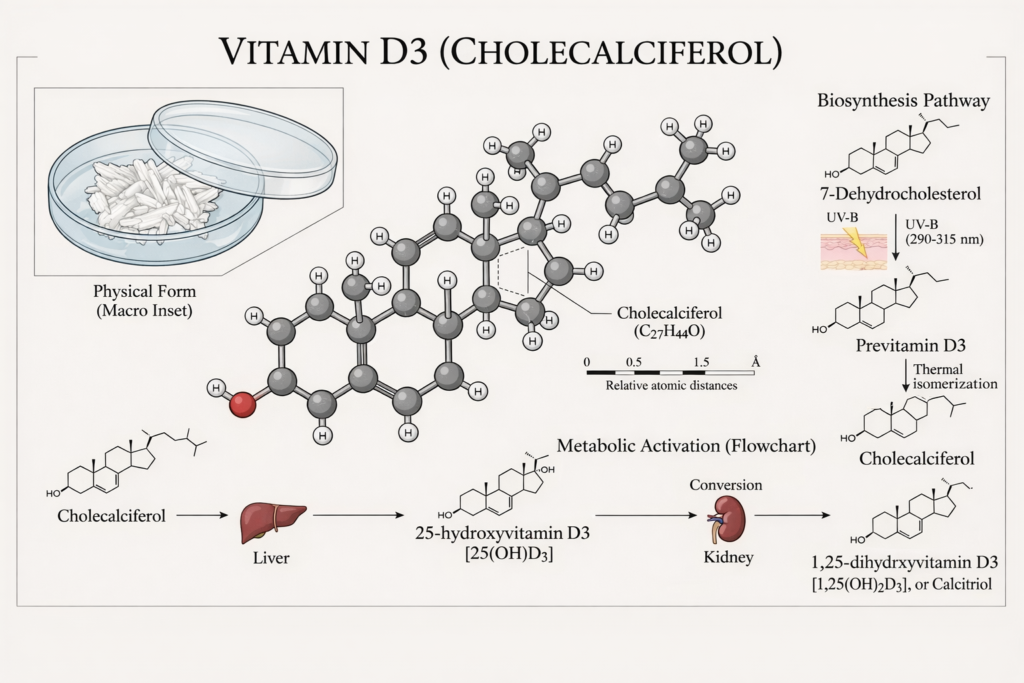
Cholecalciferol is the result of 7-dehydroxycholesterol activated by UV. It is then further degraded into calcidiol, then calcitriol. Calcitriol is the biologically active compound that the body uses. Biological functions of vitamin D3 are increasing utilization of calcium, playing a role in immune modulation and adaptive responses, and helping in muscle contraction and balance.
Sources of vitamin D3 are:
- 10-20 minutes of UVN rays (weak sun).
- Fatty fish and cod liver oil
- Beef liver
- Egg yolk
- Specific varieties of UV-exposed mushrooms
- Lichen vegan D3
Health Benefits and ethnopharmacological profile of vitamin D3
Clinical uses and Research
Nutrition-related osteomalacia and rickets: In children and infants, vitamin D3 normalized bone mineralization and healed bone lesions. It was through increasing the absorption of calcium and potassium via TRPV6 channels.
Acne Vulgaris: In acne, it was able to reduce the associated inflammatory lesion count. This is via a mild antibacterial effect as well as inhibition of interleukin 17 and inflammatory cytokines in sebocytes. (Dahlan 2024)
Prevention of osteoporosis: In postmenopausal women, it exhibited a decrease in hip and nonvertebral fracture risk. This was via suppression of parathyroid hormone to reduce bone resorption by osteoclasts.
Fatigue (non-specific and PCOS-related): The mineral decreased fatigue scores after 4 weeks, increased energy, and decreased mental fog. This was through regulation of insulin sensitivity and reducing oxidative stress in the skeletal muscle.
Respiratory tract infections: In a randomized control trial, it was able to reduce the risk of cold, flu, and asthma worsening. It induced natural antibiotics (cathelicidins/defensins) in the airway.
Pregnancy complications: In pregnant women, it lowered the risk of preeclampsia, gestational diabetes, and preterm birth. From 12 weeks onwards in pregnancy, it was able to regulate placenta development and blunt inflammatory cytokines. (Kartasuya 2025)
Autoimmune disease (multiple sclerosis): there was a 225 reduction of disease symptom incidences in confirmed cases of autoimmune disorder. This was via the modulation of T-cell differentiation.
Pre-diabetes: It delayed progression of diabetes type 2 through enhancing insulin secretion and improving sensitivity.
Cancer mortality: In one study, it reduced both incidences and mortality rates; in another study, it additionally reduced the onset of autoimmune disorders. This was through switching off genes without awaiting gene transcription and inhibition of cell proliferation and angiogenesis. (Brenner 2022)
Dosing
The typical range for adults is 800-2000 IU daily over short-term use. In infants, it is 4-6 IU daily drops. It can also be given as a 30,000, 50,000, 60,000, 150,000, 300,000, or 1,000,000 IU single or weekly/monthly dose. For supplementation or in other combinations, it can be gotten at 25, 50, 125, or 250 mcg.
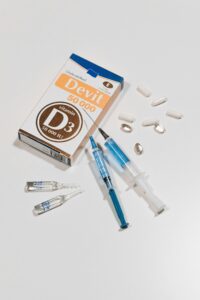
Note: Too much consumption can lead to a toxic buildup of levels in the system, leading to hypervitaminosis. It is rare.
REFERENCES
Uday S, Högler W. Nutritional rickets & osteomalacia: A practical approach to management. Indian J Med Res. 2020 Oct;152(4):356-367. doi: 10.4103/ijmr.IJMR_1961_19. PMID: 33380700; PMCID: PMC8061584.
Mohan A, Haider R, Fakhor H, Hina F, Kumar V, Jawed A, Majumder K, Ayaz A, Lal PM, Tejwaney U, Ram N, Kazeem S. Vitamin D and polycystic ovary syndrome (PCOS): a review. Ann Med Surg (Lond). 2023 Jun 5;85(7):3506-3511. doi: 10.1097/MS9.0000000000000879. PMID: 37427232; PMCID: PMC10328709.
Grant, W. B., Lahore, H., McDonnell, S. L., Baggerly, C. A., French, C. B., Aliano, J. L., & Bhattoa, H. P. (2020). Evidence that Vitamin D Supplementation Could Reduce Risk of Influenza and COVID-19 Infections and Deaths. Nutrients, 12(4), 988. https://doi.org/10.3390/nu12040988
Galoppin M, Kari S, Soldati S, Pal A, Rival M, Engelhardt B, Astier A, Thouvenot E. Full spectrum of vitamin D immunomodulation in multiple sclerosis: mechanisms and therapeutic implications. Brain Commun. 2022 Jun 30;4(4):fcac171. doi: 10.1093/braincomms/fcac171. PMID: 35813882; PMCID: PMC9260308.
Nasser, A., Papandreou, D., Papadopoulou, S. K., & Cheikh Ismail, L. (2025). The Role of Vitamin D Supplementation in Type 1, Type 2, and Gestational Diabetes: A Comprehensive Updated Narrative Review. Clinics and Practice, 15(8), 148. https://doi.org/10.3390/clinpract15080148
Reid, I. R., & Bolland, M. J. (2020). Calcium and/or Vitamin D Supplementation for the Prevention of Fragility Fractures: Who Needs It? Nutrients, 12(4), 1011. https://doi.org/10.3390/nu12041011
Leave a Reply