

Acerola is a fruit that is consumed for its nutrient-rich profile. It has also been traditionally used in the management of dysentery and fever and as an astringent. It is laden with vitamin C, A, thiamine, riboflavin, niacin, calcium, iron, malic acid, pantothenic acid, carotenoids, phenolic acids, and anthocyanidins.
Acerola is native to the West Indies, South and Central America, Texas, and Florida. It is also cultivated and naturalized in suitable microclimates in other countries like Ethiopia, Ghana, India, the Philippines, and Taiwan. Various varieties include Apodi, Cereja, Roxinha, Frutacor, BRS Rubra, Cabocla, Costa Rica, Junko, and Jaburu/Morena.
Acerola fruit has a ribbed look that creates a visual segmentation outlook. It is small, about 2 centimeters, round to spherical in shape, and the skin is glossy. It is yellow-green when unripe and shifts to orange-red when mature. Inside is pulpy with a golden to orange color and sweet, but most species are tart and acidic. It has pyrenes that contain seeds, which sit together in clusters inside the fruits.

Traditional uses of Acerola
In the Caribbean Islands, the smashed pulp was used for fever, seasonal colds, and to boost energy levels. In the Guyana regions, acerola was used in managing diarrhea, and pulp was used in wound washing. It was also used as an astringent and in dysentery.
Benefits and pharmacological profile of Acerola
Applications in allergy– It was determined to alleviate the symptoms of seasonal allergic rhinitis. It inhibited NSS and reduced releases of prostaglandin D2 into the nasal lavage fluid. This mechanism was linked to flavonoids like luteolin. Coreen 2018
Antioxidant application– Due to its high ascorbic acid and phenolic compounds, it acts as a scavenger of free radicals. Delva 2012
Vitamin C supplementation– Data shows that acerola, which is full of vitamin C, is better absorbed by humans than the commercially available synthetic vitamin C.
Hepatic profile: In animals, the polysaccharides in acerola have shown activity against nonalcoholic fatty liver disease by regulating lipogenesis and improving mitochondrial functioning. The compound was believed to act through downregulation of lipogenic signaling and improving mitochondrial function. Yin 2020
Dermatology profile– In animals, the juice suppressed B-induced skin pigmentation in a murine model. The extract acted by downregulating melanin biosynthesis genes. Uchida 2017
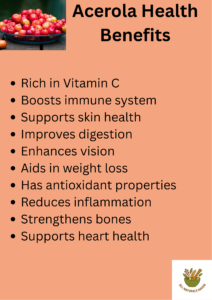
Aiding in weight loss due to its pulpy nature and low-sugar, dense fiber content. It allows for nutrition with a feeling of fullness, which regulates feeding. Regulated feeding allows for nutritional regulation, which allows for burning excess stored calories.
Boosting bone and heart health through the action of vitamin C that is used to manufacture precursors of collagen synthesis like proline and lysine. Collagen supports good bone matrix and structure. The flavonoids and polyphenol reduce the heart’s oxidative stress.
NB: Prolonged or excessive intake of acerola has been reported to cause renal calculi due to the high doses of vitamin C that increase oxalate excretion. Large doses may also cause diarrhea, nausea, and abdominal cramps. An increase in dentin permeability and rectal bezoars has also been reported.
Leave a Reply