
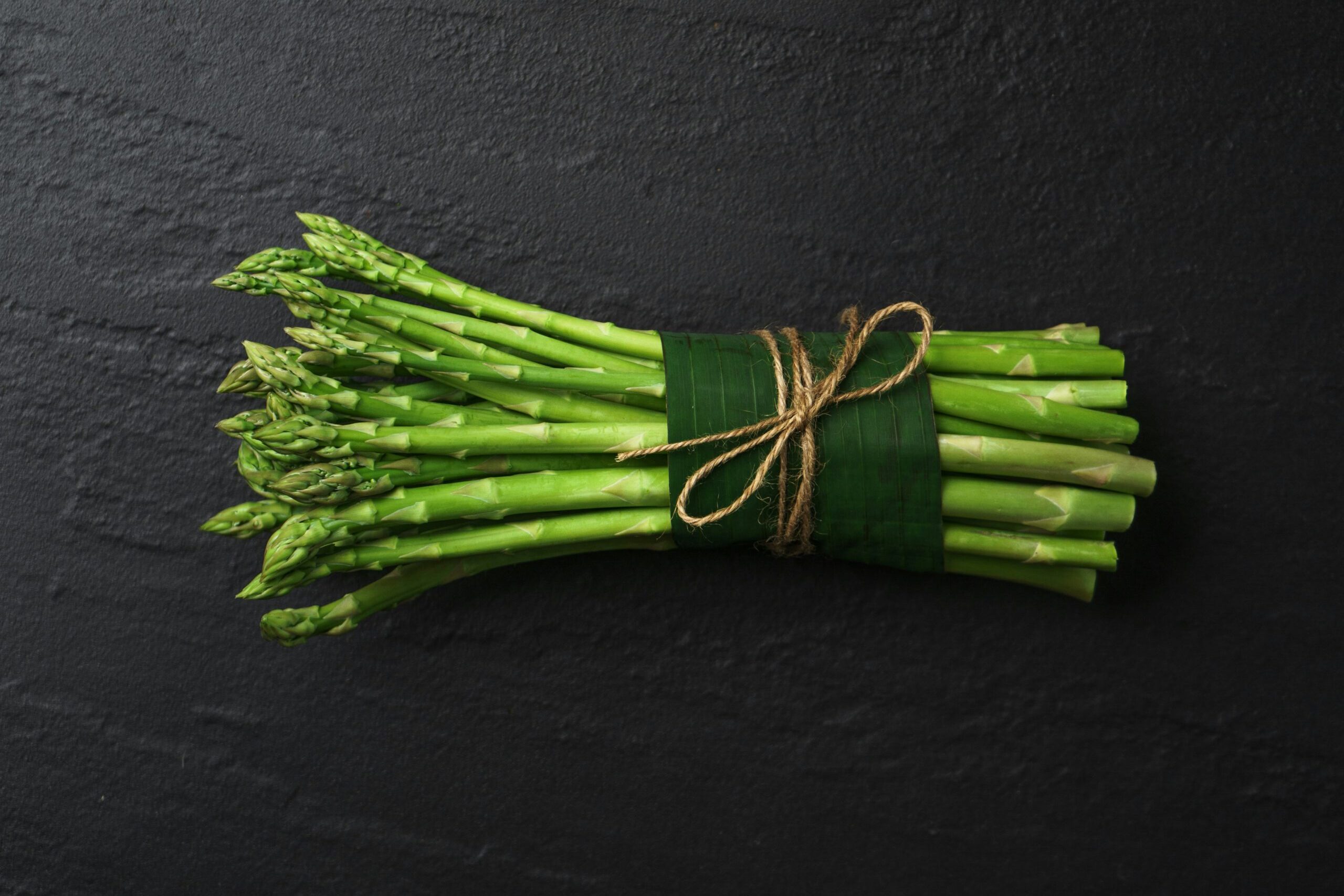
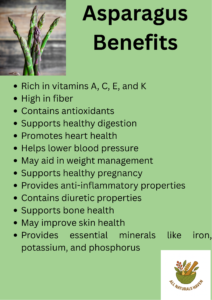
Asparagus is a plant grown for its edible parts as a spring vegetable. It is loaded with vitamins K, C, and E; folate; inulin; saponin; flavonoids; polysaccharides; and alkaloids. Its uses are outlined in the image below.
Jump to: Health Uses and ethnopharmacological profile
Asparagus Description
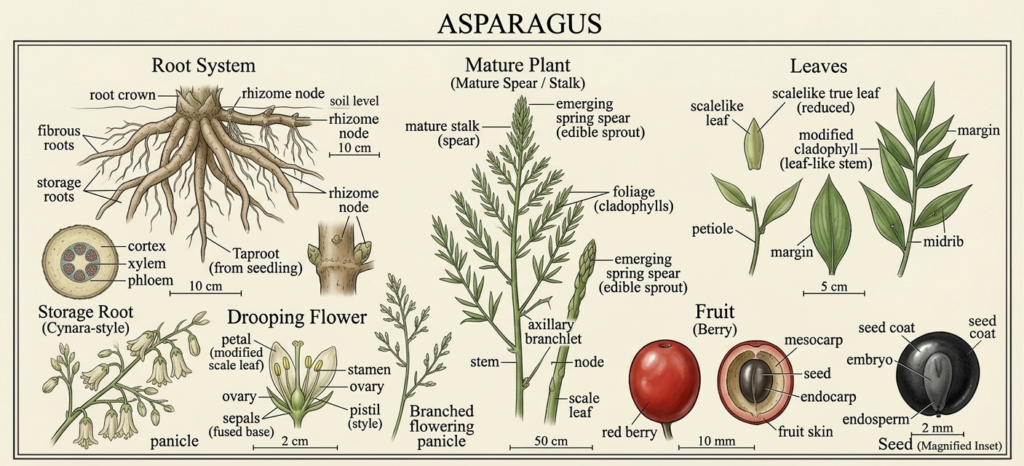
The roots of asparagus are tubular-shaped with a brown exterior and a white interior. The leaves are small and needle-like, protruding on the bark of the feather-like cladodes. The flowers are bell-shaped with red berries that are toxic in large amounts.
Asparagus is cultivated in Asia, Africa, America, Australia, and the Eastern Mediterranean. Relevant species include A. officinalis, A. recemosus, A. cochinchinensis, and A. densiflorous.
Health Uses and ethnopharmacological profile of Asparagus
Traditional uses
The extract from the plant was used as part of a rasayana tonic in Ayurvedic medicine. It was also used as an herb in lactation and reproductive support. Roots were used to relieve coughs or lung ailments.

Health Uses and Research
It serves as a nutraceutical due to its vitamins, minerals, and fiber content. Its natural fiber additionally acts as a prebiotic.
Antidiabetic potential– methanolic extract of A. officinalis extract was able to reduce blood sugar levels, improve weight, and increase serum insulin levels in rat models. 250 and 500 mg/kg per day of extract orally for 28 days. The bioactive molecules were thought to act through stimulating the pancreas to synthesize, secrete, and store insulin. Hafizur 2012
Anti-inflammatory and analgesic potential– methanolic extracts improved inflammatory lesions and rheumatoid factors. It also elicited analgesic effects in rat models linked to its saponin content, believed to work through antagonizing endogenous pain mediators like bradykinins, histamine, and serotonin.
Promoting gut bacteria potential- edible species and their root byproducts contain compounds like inulin and saponins, which support the growth of beneficial gut bacteria like lactobacilli and bifidobacteria. This promotes gut integrity and avoids opportunistic infections.
Antioxidant potential– In an in vitro study, ethanolic and aqueous extracts containing phenolic acids and rutin demonstrated increased antioxidant capacity (FRAP and ABTS).
Antihypertensive potential– enzymatic hydrolyzed stem extract showed inhibition activity of ACE enzymes in hypertensive-induced rats. The compound isolated with this activity was 2’-hydroxynicotianamine. This was confirmed through reduced formation of hippuric acid and a significant reduction in systolic blood pressure. Sanae 2013
Anticancer potential– aqueous extracts inhibited cell migration and demonstrated selective pro-oxidant activity in cancer cells. This was observed via a reduced number of metastasizing cells, altered protein expression levels, and decreased mitochondrial membrane potential. Arrinana 2021
Neuroprotective potential– In a mouse model study, an aqueous extract of 200 mg/kg and 1000 mg/kg was given for one month. The results recorded were improved cognition (i.e., improved recall), lower levels of amyloid and tau proteins, and apoptosis markers like caspase-3. An increase of heat shock proteins in the hippocampus nodded to the likely mechanism of action of preventing protein aggregation and reducing the apoptosis cascade.
NB: Eating large amounts of asparagus can cause bloating and diarrhea. If using extracts, use under the supervision of a physician and always avoid concomitant use with antihypertensives and anticoagulants due to their mild diuretic and vitamin K content.
REFERENCES
Hassan H, Ahmadu AA, Hassan AS. Analgesic and anti-inflammatory activities of Asparagus africanus root extract. Afr J Tradit Complement Altern Med. 2007 Oct 27;5(1):27-31. doi: 10.4314/ajtcam.v5i1.31252. PMID: 20162051; PMCID: PMC2816601.
Redondo-Cuenca A, García-Alonso A, Rodríguez-Arcos R, Castro I, Alba C, Miguel Rodríguez J, Goñi I. Nutritional composition of green asparagus (Asparagus officinalis L.), edible part and by-products, and assessment of their effect on the growth of human gut-associated bacteria. Food Res Int. 2023 Jan;163:112284. doi: 10.1016/j.foodres.2022.112284. Epub 2022 Dec 5. PMID: 36596190.
Çomaklı V, Sağlamtaş R, Kuzu M, Karagöz Y, Aydın T, Demirdağ R. Enzyme Inhibition and Antioxidant Activities of Asparagus officinalis L. and Analysis of Its Phytochemical Content by LC/MS/MS. Chem Biodivers. 2023 May;20(5):e202201231. doi: 10.1002/cbdv.202201231. Epub 2023 Apr 25. PMID: 37096958.
Sakurai, Takuya & Ito, Tomohiro & Wakame, Koji & Kitadate, Kentaro & Arai, Takashi & Ogasawara, Junetsu & Kizaki, Takako & Sato, Shogo & Ishibashi, Yoshinaga & Fujiwara, Tomonori & Akagawa, Kimio & Ishida, Hitoshi & Ohno, Hideki. (2014). Enzyme-treated Asparagus officinalis Extract Shows Neuroprotective Effects and Attenuates Cognitive Impairment in Senescence-accelerated Mice. Natural product communications. 9. 101-6. 10.1177/1934578X1400900130.
Leave a Reply