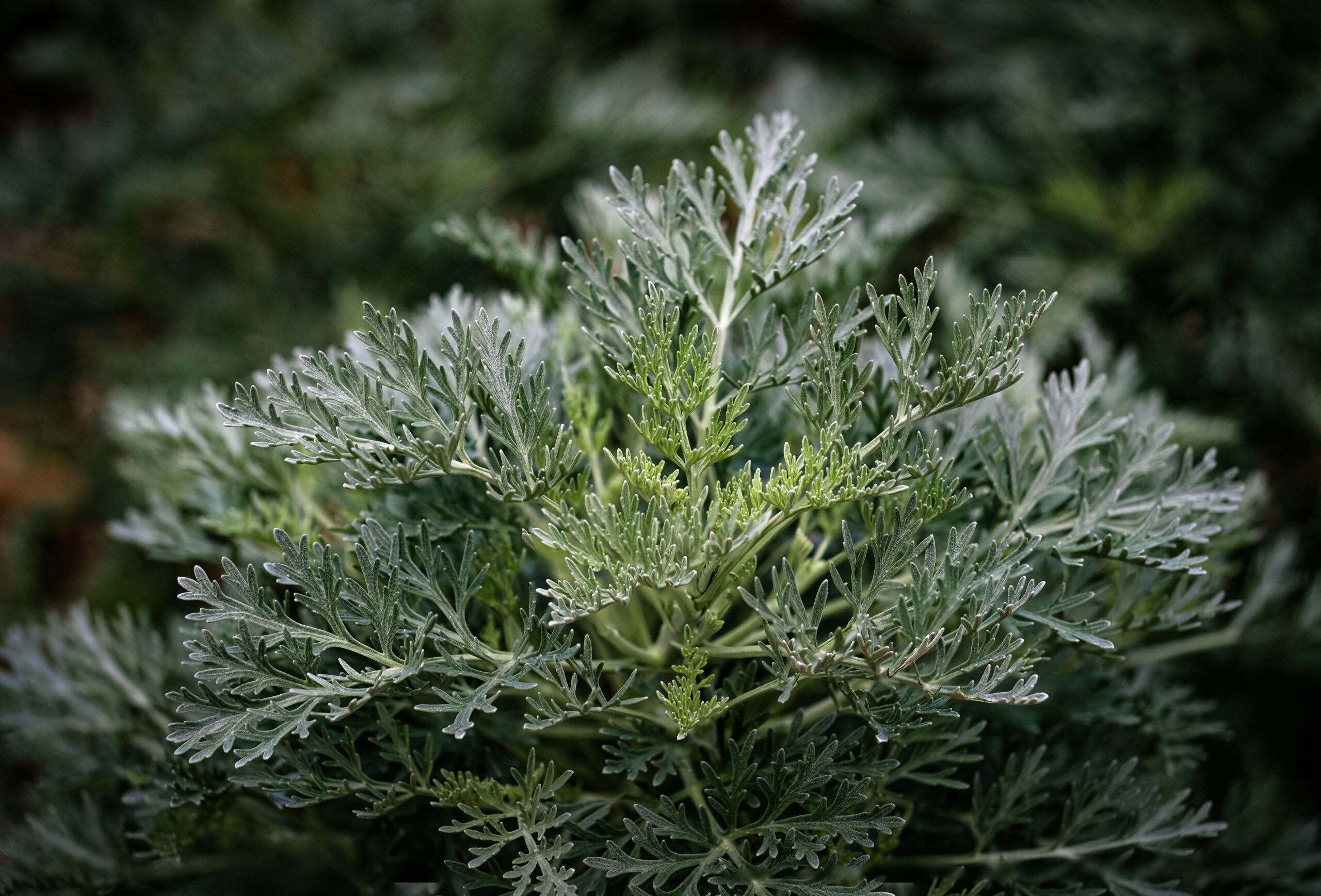
Artemisia is commonly known for its use as an antimalarial agent. It has also been used against fever. Artemisia has produced several compounds, with the first being artemisinin and later on semi-synthetic derivatives like arteether, artemether, and artesunate.
Artemisia description and compounds
Artemisia, also known as sweet wormwood, qinghaosu, and sweet sage wort, belongs to the family Asteraceae. It is native to China. Sweet wormwood is grown in other countries like Kenya, Burundi, Brazil, Bulgaria, France, Argentina, the United states, Australia, and Spain.
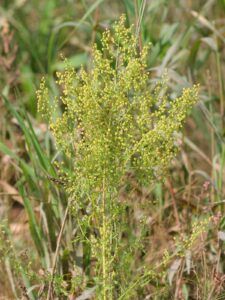
The flowers of this plant are small and yellow-greenish in appearance. They are also in clusters, which form panicles. The fruits are achenes, which are small and lack a pappus. Each fruit has a single seed. Its leaves are greenish grey in color, have dense fine hairs on the surface, and are thin. The stems are erect and striated in the upper parts; the lower parts are woody and may be covered in hairs.
Artemisia consists of sesquiterpene lactones, essential oils, flavonoids, phenolic acids and related phenolics, coumarins, polysaccharides, phytosterols, and other minor constituents.
Artemisia cultivation
Artemisia is propagated from seeds. They are planted loosely onto the soil’s surface because they need light to germinate. Once seedlings have up to 6 true leaves, they are transplanted. It thrives in a temperature of about 20-28 degrees Celsius. It does well in well-drained loam or sandy loam with a ph. of 5.5-7. It should be exposed to full sunlight to give maximum artemisinin concentration. Regular moderate watering is ideal.
Harvest is done just before full flowering, and plants are cut near the base or mid-stem; this can be done manually or mechanically. The leaves are dried in partial shade to target less than 10% moisture content. Once dry, they are stored in airtight containers and kept in a cool, dark place.
USES AND BENEFITS OF ARTEMISIA
Artemisia annua Traditional uses
In ancient China and Asia, sweet wormwood was traditionally used in the management of fevers and malaria, gastrointestinal discomforts, jaundice, and wound healing.
Artemisia annua Benefits and pharmacological profile
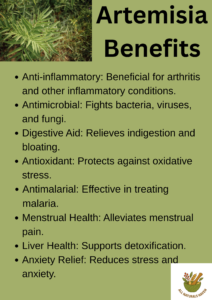
Antiparasitic activity– it has found use against all species of malaria parasites. Compressed dried leaf tablets of artemisia were used to successfully treat patients with severe malaria at 500mg twice daily for 5 days. It acts by causing membrane structural changes that kill the parasite in the erythrocyte stage. Malemo 2017
Other studies also showed activity against Trypanosoma brucei at a dose of 10mg/kg in mice. Efferth 2018
Uncomplicated cutaneous leishmaniasis activity– treatment with 30g of leaf powder extract for 20 days resulted in decreased ulcers and gradual cure after follow-up (mesa 2017) Vasquez 2017
Respiratory diseases activity– in clinical setting, sublingual administration of artemisinin drops for 32 weeks in patients with seasonal allergic rhinitis experienced reduced congestion, rhinorrhea, and other symptoms except for watery eyes. It acts through a combination of airway remodeling and anti-tumor/inflammatory effects. Huang 2020
Anti-arthritis properties-Patients given artemisinin ethanolic extract at 30 g once daily in combination with DMARDs experienced significant improvement of pain, and at 48 weeks, the painful joints, rheumatoid factor levels, and number of swollen joints were significantly improved. Yang Guo 2017
Anticancer potential– the derivative artesunate may be effective in treating cancers that overexpress transferrin receptors by causing an influx of iron, which in turn causes the formation of free radicals by causing molecular damage, leading to cell death. (lai 1995) Newer studies with extracts from pressurized cyclic solid-liquid extraction elicited a higher toxicity and induced apoptosis to a greater degree in comparison with traditional extracts. Bosso 2021
Artemisia Dosing
Artemisia can be found in the following forms:
Tablets– powders compacted into tablets, either raw or synthesized into pharmaceutical products as a combination, i.e., artemether-lumefantrine tablets.
Dried leaf powder- used to make infusions
Tinctures– from ethanolic extracts mainly used in clinical settings
IV and IM formulations of artemisinin derivatives
- 5 grams can be used daily for a maximum of 5 days as an infusion.
- Raw leaf powder Capsules of between 3-5 g can be taken thrice daily in divided doses for 7 days.
- 150 mg twice daily for 12 weeks in arthritis (extract)
- 500 mg twice daily for 5 days in malaria (extract)
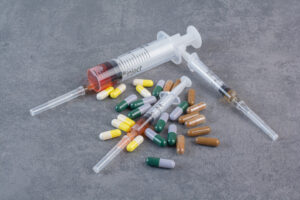
Artemisia Side effects and Interactions
Reported side effects of artemisia and its derivatives include:
- Nausea and vomiting
- Allergic reactions like rashes
- Dizziness and headache
- Abdominal pain and mild diarrhea
Anti-tuberculosis drugs like rifampicin can induce artemisinin, risking failure of treatment; hence, use with caution.
Monitor if used with antiarrhythmics and antipsychotics, as well as some antibiotics like macrolides, as it increases the risk of QT prolongation.
NB-Avoid use in the first trimester of pregnancy, as it has a toxic effect in the embryonic stage of a fetus’s development.
Leave a Reply