
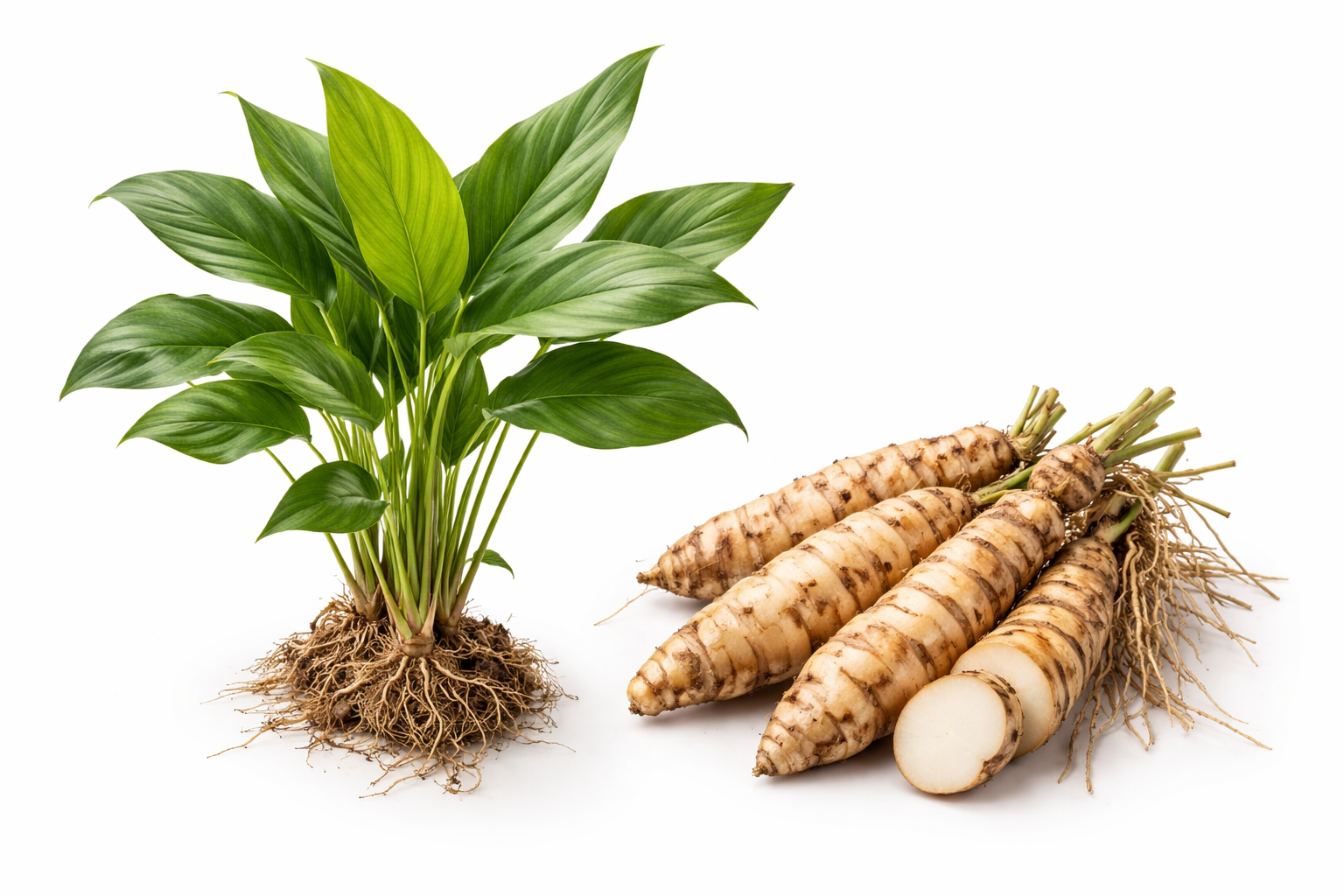
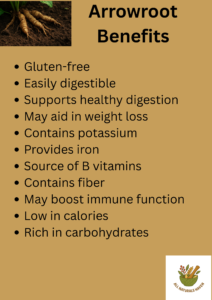
Arrowroot, a starchy root vegetable, has been a delicacy in many parts of the world where it was native by extracting starch through its powdered flesh. It belongs to the family Marantaceae and is rich in carbohydrates, protein, fat, fiber, folate, phosphorous, iron, and potassium. It is gluten-free. Its uses are outlined in the image below.
Jump to: Health uses and ethnopharmacological profile
Arrowroot Description
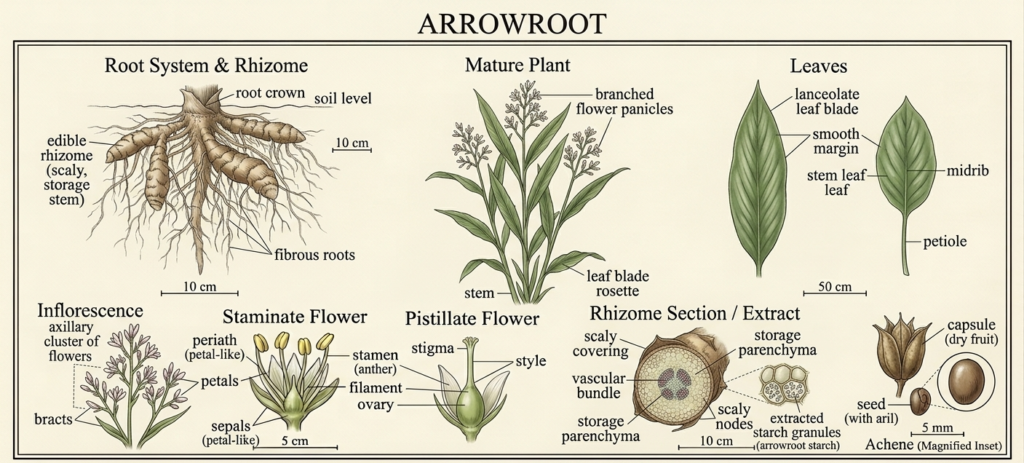
Arrowroot flowers are small and occur in clusters with purplish, green, or whitish colors. The stems stretch above to support the leaves that occur alternately on the stems and below to support the rhizomes. The rhizomes are shaped like fingers and are about 10-20 centimeters long with a brownish outside and a whitish inside.
The plant is native to the tropical Americas and is also found in countries like Ghana, Kenya, Thailand, South/North America, and the Caribbean Islands. Species of importance are Canna indica (canna), Tacca leontopetaloides (Polynesian), curcuma angustifolia (E. Indiana), and Zamia integrifolia (Florida).
Health uses and ethnopharmacological profile of Arrowroot
Traditional uses
It was mainly used as food. Traditionally used to manage diarrhea due to its starchy content that helps to firm stool. Its powder, mixed with coconut oil, is used to make an organic deodorant. It can also be used as a component of dry shampoo and powder for skin.
Health uses and Research
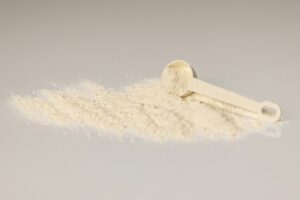
As a gluten-free diet, the powder is used in baking or thickening sauces as an alternative for people with allergies.
Aids in weight loss– due to its high soluble fiber content, it induces a feeling of prolonged fullness that in turn controls the amount and number of feeds. This creates a calorie deficit and promotes weight loss.
Antidiarrheal agent– methanol extract of 200-400 mg/kg reduced the frequency of stool movements, thus aiding in the management of diarrhea in vivo.
Antioxidant profile– ethanolic extract of 125/250/500 mg/kg in rats for 14 days elicited improved markers for lipid peroxidation and enzyme markers like SGPT in vivo. Ramadhani 2017
Immunostimulatory effects– water extracts administered to rats improved IgG, IgA, and IgM. Polyphenols and luteolin compounds were suspected to act through the activation of beta lymphocytes and the modulation of cytokine signaling that is responsible for Ig synthesis.
Blood sugars effects– tuber extracts at 150 mg per day for 28 days on mice showed a 40.5% reduction in blood glucose and reduced tolerance, the proposed action of flavonoids being able to improve glucose uptake by activating AMPK and insulin signaling pathways in the liver.
Antimicrobial effects– extract powder feeding showed effects against harmful bacteria, staph aureus, through disruption of cell membranes and oxidative stress induction (Syaphutra2020).
Ethanoic/hexane extracts showed vibriocidal effects against Vibrio cholerae. Some phenolics showed activity by inhibiting cholera toxin-related pathways, limiting its pathogenicity.
Increase in short-chain fatty acid genera like L. lagilactobacillus, thus boosting the normal flora and enhancing metabolic processes. Pangastuti 2025
NB: Arrowroot is often confused with other tuber crops like cassava, taro, or yams. The difference is that it is not usually cooked or boiled but rather farmed for its starch content, which is used as a powder in other preparations, i.e., as a thickener in herbal preparations.
REFERENCES
Rahman MK, Chowdhury MA, Islam MT, Chowdhury MA, Uddin ME, Sumi CD. Evaluation of Antidiarrheal Activity of Methanolic Extract of Maranta arundinacea Linn. Leaves. Adv Pharmacol Sci. 2015;2015:257057. doi: 10.1155/2015/257057. Epub 2015 Aug 6. PMID: 26346095; PMCID: PMC4543376.
Kumalasari ID, Harmayani E, Lestari LA, Raharjo S, Asmara W, Nishi K, Sugahara T. Evaluation of immunostimulatory effect of the arrowroot (Maranta arundinacea. L) in vitro and in vivo. Cytotechnology. 2012 Mar;64(2):131-7. doi: 10.1007/s10616-011-9403-4. Epub 2011 Oct 25. PMID: 22038480; PMCID: PMC3279578.
Pangastuti, A. ., Anggraini, P. R., Listyawati, S., & Sari, S. L. A. (2025). Arrowroot (Maranta arundinacea L.) Tuber Extract Modulated Gut Microbiota and Improved Glycemic Control in Type 2 Diabetic Mice. HAYATI Journal of Biosciences, 33(2), 371-381.
Samal, P.; Tripathy, P.; Das, R.; Sahoo, S. L.; Pradhan, C.; Padhi, B. K.; Rout, J. R. Vibriocidal Activity of Leaf and Rhizome Extracts of Maranta arundinacea L.. Preprints 2018, 2018100405. https://doi.org/10.20944/preprints201810.0405.v1
Leave a Reply